The South End's Real Backyard Isn't a Yard at All
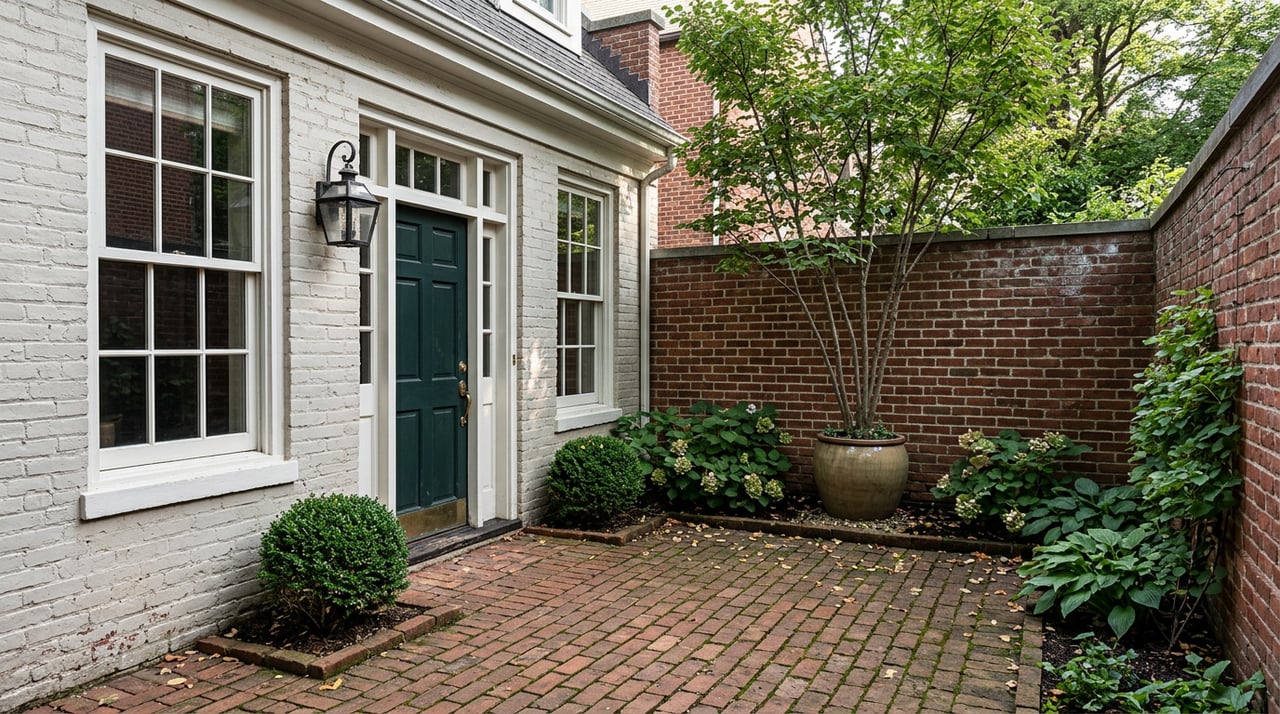
Walk any street between High Street and Water Street on a Sunday morning and you'll notice the same thing: front doors opening onto brick sidewalks, a patio here, a strip of garden there, but almost no one is spending the morning in their own outdoor space. They're headed somewhere else. Ask a longtime South End resident where they're going and the answer is almost always the same cluster of buildings on Water Street where the neighborhood's old leather-tanning mills used to stand.
That's not a coincidence, and it's not really about the produce.
The South End is the oldest developed part of Newburyport, and its housing stock shows it. First Period, Georgian, and Federal-era homes line the streets from High Street down to Water Street, with pockets of Italianate and Greek Revival mixed in. These are dense, historic lots. Patios and small side yards are the norm here, not the sprawling backyards you'd find in a newer subdivision a few miles inland.
That architectural fact matters more than it looks like it should. If your outdoor living space is a brick patio the size of a parking spot, you don't garden your own vegetables, you don't host thirty people for a cookout, and you don't really have a place to run into six neighbors on a Saturday. You need somewhere else to do those things. In the South End, that somewhere else is the Tannery Marketplace, a cluster of converted mill buildings a short walk from most of the neighborhood's front doors.
The Newburyport Farmers' Market sets up in the Tannery's parking lot every Sunday from 9am to 1pm, rain or shine, for its full season running from May into November. The 2026 season opened May 3. When the weather turns, the market doesn't disappear. It moves into a heated event tent on the property and runs twice a month from 10am to 2pm, December through April, so there's rarely a stretch of the year when Water Street goes quiet on a Sunday.
| Season | Frequency | Hours | Location |
|---|---|---|---|
| Summer market (May–November) | Every Sunday | 9am–1pm, rain or shine | Tannery Marketplace parking lot, 50 Water St |
| Winter market (December–April) | Twice monthly | 10am–2pm | Heated tent, Tannery Marketplace |
That's a fixed, dependable slot on the calendar, which is exactly what a neighborhood without much private outdoor space needs. You don't need a yard to host people if you can walk everyone three blocks to a market with live music and a rotating list of local farms, fishermen, and bakers.
The market itself is the draw that gets people out the door, but the converted mill buildings around it, spanning both sides of Merrimac Street, are where the morning usually turns into an afternoon. A short list of what's inside:
None of this reads like a shopping center built for out-of-town visitors, even though visitors do come. It reads like a neighborhood's errand list compressed into one walkable footprint, which is a different thing entirely. A resident who doesn't have a proper kitchen garden buys herbs and greens at the market. A resident who doesn't have room to host a dinner party picks up prepared food from Joppa Fine Foods or grabs a table at Epicureo instead. The Tannery isn't replacing yard space with retail. It's replacing yard space with the specific errands and gatherings a yard would otherwise make possible.
The site has a history that explains why it works this way. In 1985, Prime Tanning Co. sold its Newburyport tanneries to developers Hall and Moskow, who handled the environmental cleanup and converted the old industrial mills into what became the Tannery Mall. Part of the original plan was to offer low-cost incubator space for entrepreneurs alongside competitively priced retail, and that mix is still visible in the directory today. Alongside the restaurants and shops, you'll find a dance studio, an art gallery, a drum and music shop, massage and salon services, and small professional offices including tax planning and real estate. It's less a mall in the conventional sense and more a small, mixed-use village that happens to be housed in old brick mill buildings.
The property has also kept leaning into a sustainability identity that fits its industrial-reuse story. Hall and Moskow installed roughly 400 rooftop solar panels to cover most of the common area's power needs, and the Tannery was among the first properties in New England to experiment with heliostats, computer-operated mirrors used to melt stockpiled snow. It's a small detail, but it's the kind of thing that tells you this isn't a generic strip mall dressed up in exposed brick. Someone has been quietly reinvesting in the bones of the place for decades.
None of this is dressed up as a real estate story, because it isn't one. It's a description of how a neighborhood with limited private outdoor space has organized its shared life around one recurring, walkable gathering point. The Tannery Marketplace didn't get built as the South End's town square. It became one, because a neighborhood full of Federal-era rowhouses with tight patios needed somewhere to be outside together, and a former tannery on Water Street happened to be sitting there with parking, converted mill space, and enough square footage to hold a farmers market every week of the year.
If you've lived in the South End for any length of time, you already know this without being told. What's worth noticing is how deliberate the pattern actually is. The market's producers rotate with the seasons. The winter tent keeps the rhythm going when the weather doesn't cooperate. The restaurants inside the buildings cover the gap for anyone who doesn't have room to entertain. It's not an accident that this particular corner of the neighborhood carries so much of its social weight. It's the direct result of what the neighborhood's housing stock does and doesn't offer, and the market has simply filled in the difference.
Next Sunday, if you're heading down Water Street for coffee and whatever Chococoa has in the case that morning, you're not just running an errand. You're doing exactly what the South End's architecture has quietly been asking residents to do for two hundred years: find your outdoor space somewhere other than your own address.
If you're thinking about what a move within the South End, or into it, might actually look like given how the neighborhood really lives day to day, Person + Person Group can walk you through it. Download the Newburyport Guide or request a personalized market plan whenever you're ready to talk specifics.
Whether you're simply thinking of buying or selling a home, or know someone who is, we're here to ensure your real estate experience is a great one. Let us help you find your dream home or investment property.