Understanding Plum Island’s Different Home Areas
Wondering how one small barrier island can feel so different from block to block? On Plum Island, that question matters because your day-to-day experience can change based on how close you are to the Point, the beach access streets, or the quieter stretches farther away. If you are thinking about buying or selling here, understanding those patterns can help you judge lifestyle, access, and property value more clearly. Let’s dive in.
On the Newburyport side, Plum Island is the island’s north end. According to the city’s master plan, this residential area began in 1920 with small weekend residences and camps tied to fishing and other marine-based activity. Over time, lot combinations and larger rebuilds helped shape the year-round homes you see today.
That history helps explain why Plum Island does not always feel like a neatly planned subdivision. For most buyers, the island makes more sense when you think about three broad patterns: the Point area, the ocean-side street blocks, and the river-facing sections. Those distinctions are practical, and they often affect access, visitor activity, and how a home lives.
The Point is the most public-facing part of Newburyport’s Plum Island. The city-managed Plum Island Point Beach & Parking Lot is here, with space for 120 vehicles and entry off Northern Boulevard near 278 Northern Blvd. The city does not allow lot entry through Reservation Terrace.
Because this is the island’s main public beach operations area, homes near the Point are often closest to boardwalks, designated access trails, and managed beach circulation. In summer, that usually means more activity nearby than in other parts of the island.
Northern Boulevard and Reservation Terrace are often part of the same conversation because they sit near this access hub. That said, access patterns matter. The city’s parking layout routes beach traffic through Northern Boulevard rather than Reservation Terrace, which shapes how people move through the area.
If you like being close to one of the island’s best-known public access points, the Point area may appeal to you. If you prefer a setting with less seasonal movement, you may want to compare it carefully with homes farther from this northern cluster.
The city’s beach-management plan identifies ocean access at 53rd, 55th, 57th, and Grant Streets. These access points use footpaths and on-grade Mobi-Mats instead of one large central parking area.
That setup gives the ocean-side blocks a different rhythm than the Point. Rather than centering around one major lot, activity is spread across several beach access streets.
In practical terms, these blocks tend to feel more beach-house oriented. You are often thinking about direct sand access, seasonal foot traffic, and the experience of living close to the Atlantic side rather than near a neighborhood center.
For many buyers, that is part of the appeal. The tradeoff is that homes near access streets may see more people passing by during peak beach season than homes tucked farther away from those entry points.
On the Newburyport end of Plum Island, buyers sometimes use the word “bayside” to describe homes with a more sheltered feel. In this area, that usually points to the river- and sound-facing side rather than the open ocean side.
City beach-planning materials describe the riverfront area as stretching from the northern tip of Plum Island to the South Jetty. Homes in this zone are closest to the Merrimack River mouth and the city’s main public beach operations.
The river-facing sections can feel notably different from the Atlantic-facing blocks. The setting is shaped less by open-beach frontage and more by proximity to the riverfront access zone and the island’s working edge where land, water, and public access meet.
For some buyers, that means a more sheltered coastal feel. For others, it means looking closely at exactly where a property sits in relation to the Point and public access activity.
Not every part of Plum Island carries the same seasonal energy. Streets farther from the Point and the main access points generally feel quieter and more private, with less visitor turnover.
That does not mean they are disconnected from the island lifestyle. It simply means your daily experience may be shaped more by residential use and less by beach traffic. For buyers who want Plum Island character without the strongest summer buzz, these stretches are often worth a closer look.
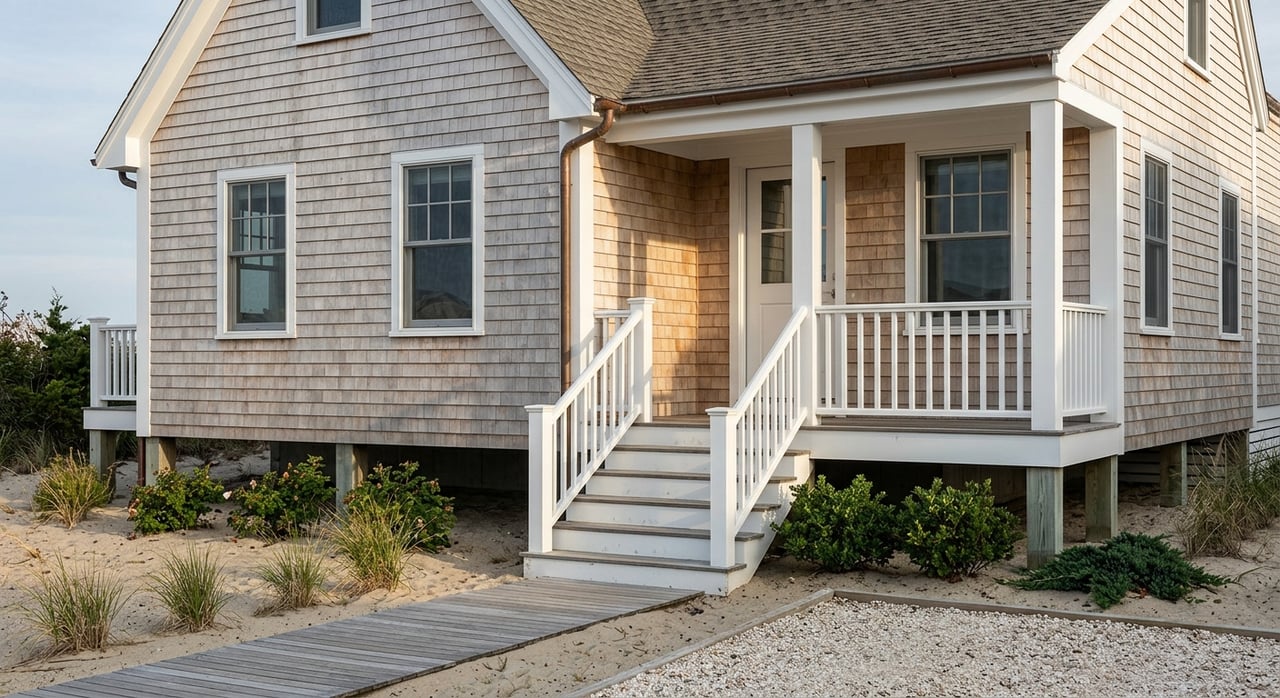
Plum Island homes often have a look that differs from mainland neighborhoods. The city’s homeowner guide says new or substantially improved structures must be elevated at least two feet above the FEMA flood elevation or the ground surface.
The same guide says fences should allow sand to move freely, and new paving should use pervious materials such as gravel, shells, or crushed stone rather than solid paving. Those rules help explain why you often see raised cottages, expanded beach houses, open foundations, and low-impervious outdoor areas instead of traditional lawns, curbs, and paved driveways.
The original 1920 layout still influences the island today. Even though homes have grown and some lots have been combined, current city filings show that existing lots can be compact and often nonconforming to modern dimensional controls.
For example, one 68th Street filing listed an existing 4,642-square-foot lot against an 8,000-square-foot requirement. A Reservation Terrace filing listed an existing 4,285-square-foot lot against a 12,000-square-foot requirement. For buyers and sellers, the takeaway is simple: lot shape, frontage, setbacks, parking, and usable open space can matter just as much as raw lot size.
Plum Island’s seasonal rhythm is not just a feeling. It is reflected in how the city manages the beach. Municipal lots are paid and enforced, the city offers mobile payment for municipal lots, and the health department conducts weekly summer water testing at Plum Island Point Beach.
The city also manages designated paths, boardwalks, signage, dune protection, and beach-cleaning cycles. That creates a beach environment that is organized and actively maintained, especially during the busiest months.
If you are comparing homes, access is not a small detail. It affects noise, parking patterns, visitor presence, and how quickly you can reach the sand or riverfront.
It also matters during weather events. The city reported a temporary closure of Plum Island Turnpike during high-tide flooding in January 2024 before it reopened later that morning. That is a useful reminder that on a barrier island, access is part of the living experience, not just the commute.
For buyers, the best Plum Island location is usually the one that matches how you want to live. If you want easy public beach access and the energy that comes with it, the Point or ocean-access streets may be a strong fit. If you want a quieter setting, it helps to focus on streets farther from the main parking and beach entry areas.
For sellers, these differences are also important because they shape how a home should be positioned in the market. A property near the Point may be marketed around convenience and access, while a home on a quieter stretch may be presented around privacy and a more tucked-away island feel.
On Plum Island, small location differences can have a big impact on buyer perception. That is why local context matters so much when you are pricing, preparing, or evaluating a property.
If you are considering a move on Plum Island or elsewhere in Newburyport, working with a team that understands coastal property patterns, design presentation, and local nuance can make the process much clearer. Connect with Dolores Person for tailored guidance on buying or selling in this unique coastal market.
Whether you're simply thinking of buying or selling a home, or know someone who is, we're here to ensure your real estate experience is a great one. Let us help you find your dream home or investment property.